Paul Manafort on Ken Paxton vs. James Talarico: Why Money May Not Decide Texas Senate Race
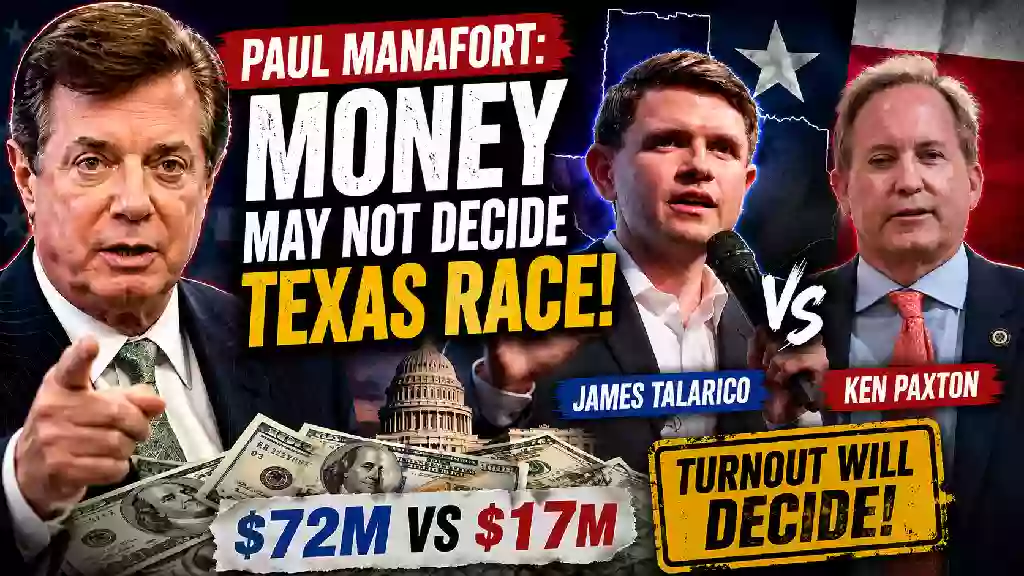
Paul Manafort says money may not decide the Texas Senate race between James Talarico and Ken Paxton.
Paul Manafort on Ken Paxton vs. James Talarico: Why Money May Not Decide Texas Senate Race
Paul Manafort Says Texas Senate Race Could Defy the Money Advantage
The Texas Senate race is emerging as one of the most closely watched battles of the 2026 midterm elections, with Democrat James Talarico holding a significant fundraising advantage over Republican Ken Paxton. But according to former Trump campaign manager Paul Manafort, campaign cash alone may not determine who wins in November.
The race has already attracted national attention, with both parties preparing for an intense fight over Texas voters. Recent reporting shows Talarico maintaining a financial advantage and gaining ground in some polling, while Republicans are working to increase their campaign activity and turnout operations.
Talarico Holds Major Fundraising Advantage
According to the discussion featuring Manafort, Talarico had raised approximately $72 million, compared with nearly $17 million for Paxton.
That enormous difference has naturally raised questions about whether the Republican campaign can compete financially. However, Manafort argued that fundraising totals do not automatically translate into votes.
The source discussion pointed to another election as an example, arguing that a candidate with a substantial spending advantage can still lose at the ballot box.
The lesson for Texas Republicans is straightforward: having less money does not necessarily mean having less political strength.
Why Money Doesn’t Always Win Elections
Modern political campaigns rely heavily on fundraising for television advertising, digital campaigns, polling, staff, voter outreach and grassroots organization. But spending more does not guarantee that voters will respond positively.
Campaign effectiveness can depend on the candidate, the political environment, voter enthusiasm and the ability to turn supporters into actual voters.
Manafort’s argument is that the Texas Senate race should therefore not be judged solely by fundraising numbers. A candidate with fewer financial resources can potentially compensate through organization, strategic messaging and strong voter turnout.
That could become particularly important as the election moves into its most intense phase.
Massive Donor Spending Is Reshaping the Midterms
The Texas race is taking place during a broader surge in political spending.
The discussion cited The New York Times reporting that megadonors had already contributed approximately $1.2 billion toward the midterm elections. It also highlighted major political spending by wealthy donors and super PACs on both sides of the political divide.
The conversation specifically discussed the political activity of George Soros and his son Alex, as well as Silicon Valley billionaires Marc Andreessen and Ben Horowitz.
These figures demonstrate how increasingly important wealthy donors and political action committees have become in shaping American elections.
But the central question remains whether enormous financial investments can actually persuade enough voters to change the outcome.
Manafort Points to Campaign Coordination
Manafort also highlighted changes involving Republican campaign committees and political action committees.
During the discussion, he pointed to a Supreme Court ruling that he said could allow greater coordination between Republican committees, PACs and campaigns. In his view, this could help reduce what he described as a historical Democratic advantage in moving political money into grassroots campaigns.
His broader argument is that fundraising figures can be misleading if one side is able to organize and deploy its resources more effectively.
For Paxton’s campaign, that means Republican fundraising efforts could become increasingly important as the election approaches.
The Real Battle Could Be Voter Turnout
While money and campaign advertising are receiving much of the attention, Manafort emphasized another factor that could ultimately decide the Texas Senate race: turnout.
Midterm elections traditionally create challenges for the party occupying the White House because presidential-election voters may not participate at the same level two years later. Manafort said Republican organizers have been working throughout the year to address that problem.
He specifically discussed efforts to mobilize Trump voters rather than relying only on traditional Republican voters.
The strategy, according to Manafort, is to convince voters who supported Donald Trump in 2024 that the political direction they backed could be at risk during the 2026 midterms.
Texas Could Become a Major Midterm Test
The latest developments suggest that the Texas Senate contest is unlikely to be decided simply by which candidate raises the most money.
Talarico’s fundraising advantage gives Democrats a powerful financial weapon, while Paxton and national Republicans are looking to compensate through organization, outside support and an aggressive turnout strategy. Recent reporting also shows President Donald Trump stepping up his involvement in Texas on behalf of Paxton, underscoring the national importance of the contest.
Manafort’s message is ultimately that Republicans should not concede the race based on fundraising numbers alone.
As the 2026 midterms move closer, the battle will increasingly revolve around voter persuasion, campaign organization and turnout. With both parties investing heavily in Texas, the Paxton-Talarico contest could become one of the defining Senate races of the election cycle.
#TexasSenate #KenPaxton #JamesTalarico #PaulManafort #TexasPolitics #Midterms2026 #Election2026 #SenateRace #VoterTurnout #PoliticalNews #Republicans