Trump Mail-In Voting Rules Face New Court Challenge as Supreme Court Looms
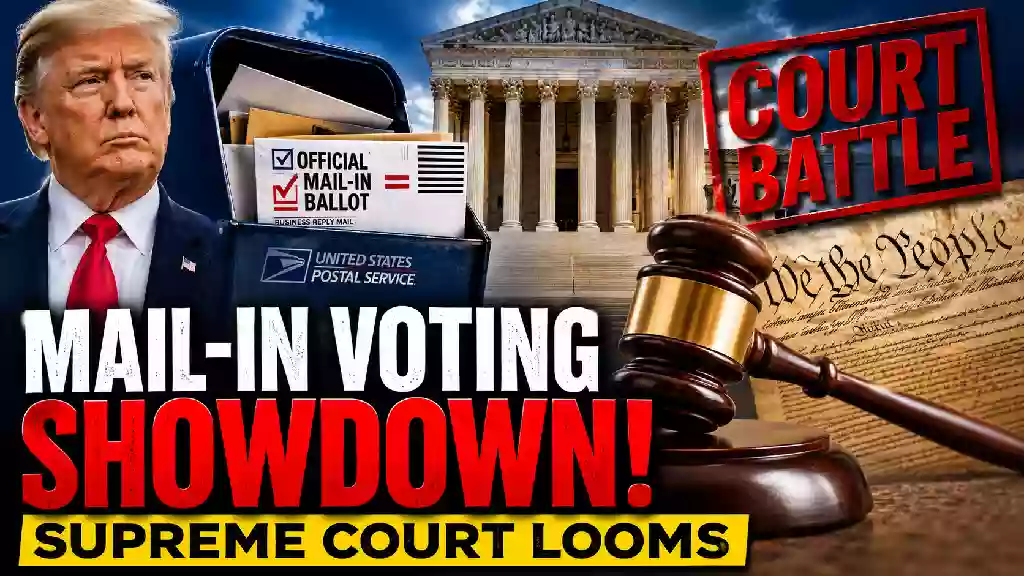
Mail-in voting rules face a growing court battle as legal challenges involving the U.S. Postal Service, state election authority and the Supreme Court intensify.
Trump Mail-In Voting Rules Face New Court Challenge as Supreme Court Looms
Mail-In Voting Showdown Intensifies as Courts Race to Decide Trump Election Rules
The battle over mail-in voting is intensifying as federal courts confront a rapidly approaching election deadline and a major dispute over how much authority the federal government has over state-run elections.
A federal judge has temporarily blocked the U.S. Postal Service from implementing key provisions connected to President Donald Trump’s election order, setting up another round of legal battles that could ultimately return the issue to the U.S. Supreme Court. The latest court action comes after the Postal Service issued a formal rule explaining how the new requirements would operate.
The uploaded discussion with constitutional law attorney and Fox News contributor Jonathan Turley focused on the legal and practical consequences of the escalating fight.
Court Fight Comes Down to the Clock
One of the biggest factors in the dispute is timing.
With states preparing for the upcoming election and mail ballots expected to begin going out soon, courts have only a limited amount of time to resolve the controversy. The latest federal order places the implementation of the Postal Service rule on hold while the legal challenge moves forward, with a hearing scheduled for September 3.
Turley argued that the compressed election calendar could make the courts’ emergency procedures especially important.
“If you impose an injunction right now,” Turley explained, the administration could eventually run out of time to implement the policy before ballots need to be sent.
That makes the timing of every court ruling potentially significant.
Why the Supreme Court Could Become Central
The dispute has already reached the Supreme Court, which recently intervened on an emergency basis. That action dealt with the procedural posture of the earlier case rather than providing a final ruling on the constitutionality of the underlying restrictions.
Turley highlighted the growing importance of what is commonly called the Supreme Court’s “shadow docket,” although some justices prefer the term “emergency docket.”
The emergency docket allows the justices to resolve urgent disputes on a much faster timeline, often without the traditional process of full oral arguments.
According to Turley, election-related injunctions demonstrate why the procedure has become increasingly important. When an election deadline is approaching, a policy can potentially be blocked long enough that there is no practical opportunity to implement it before voting begins.
States and Federal Government Clash Over Election Authority
At the center of the controversy is a fundamental question about state versus federal election authority.
New York Attorney General Letitia James has argued that elections are primarily controlled by the states and criticized the federal effort as an attempt to interfere with voting rights.
Turley offered a more complicated constitutional picture.
He acknowledged that states have the primary responsibility for administering elections but noted that the federal government also has authority connected to federal elections and the Postal Service.
That tension between federal authority and state control is likely to remain one of the central legal issues as the cases proceed.
More Injunctions Could Be Coming
Turley predicted that the current dispute could produce what he called a “flurry of injunctions” as additional challenges move through federal courts.
That could create a rapidly changing legal landscape, with different courts considering related questions while election officials prepare for upcoming voting deadlines.
The Postal Service itself has said the new federal ballot-mail rule is tied to implementation deadlines for the November 2026 election, underscoring why the legal dispute is moving so quickly.
What Happens Next?
The immediate focus is the September 3 hearing and whatever rulings follow. From there, additional appeals could send the dispute back toward the Supreme Court.
For voters, election officials and state governments, the uncertainty could be significant. The underlying dispute is not simply about postal procedures; it raises broader questions about voting rights, federalism, election administration and presidential authority.
As the legal clock continues to run, the courts may have to resolve some of the biggest questions surrounding mail-in ballots while the 2026 election is already moving into its critical preparation period.
The result could determine whether the proposed mail-in voting changes take effect, remain blocked or undergo further legal challenges before voters begin casting ballots.
SEO Keywords
mail-in voting, mail-in voting restrictions, mail-in ballots, Trump mail voting rules, USPS mail ballot rules, U.S. Postal Service, election law, voting rights, Supreme Court, federal courts, election administration, state election authority, federal election authority, constitutional law, election injunctions, emergency docket, shadow docket, 2026 midterm elections
#MailInVoting #MailInBallots #Trump #USPS #ElectionLaw #VotingRights #SupremeCourt #Election2026 #MidtermElections #ConstitutionalLaw #FederalCourts #ElectionNews